


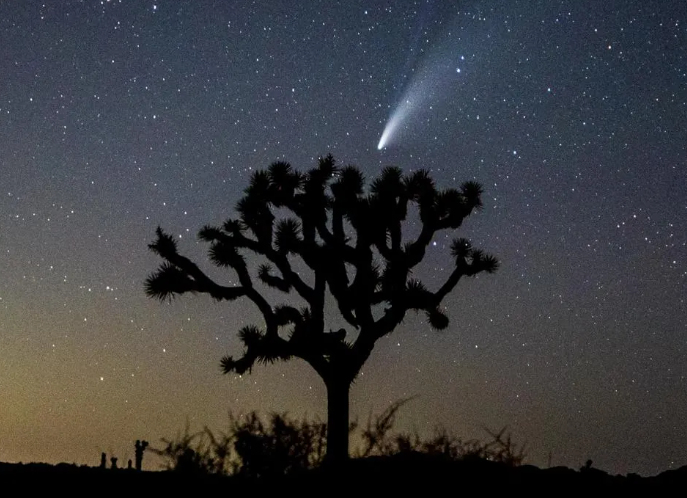
Days after astronauts on NASA’s Artemis II mission witnessed a total solar eclipse from the moon’s far side, a new comet is emerging in the predawn sky — and it could soon become visible to the naked eye. After a widely followed moon mission, this comet offers a rare chance for anyone to witness a dramatic event in the night sky without special equipment. Here’s everything you need to know about comet Pan-STARRS, also known as comet C/2025 R3 (Pan-STARRS). Check my feed for a frequent comet tracker with sky-charts and tips for viewing comet Pan-STARRS.
Key Facts
Comet C/2025 R3 (Pan-STARRS) is currently brightening and is already technically a naked-eye object in very dark skies. It now looks set to brighten over the next 10 mornings, becoming easier to see.
It was found by the PanSTARRS survey at Haleakala, Hawaii, on Sept. 7, 2025. It’s reckoned to orbit the sun about every 170,000 years.
The comet will reach perihelion (closest to the sun) on Sunday, April 19, passing at a safe distance of about 0.5 AU — half the Earth-sun distance — meaning it is unlikely to disintegrate like last week’s “sungrazer” comet MAPS, which vaporized.
Comet Pan-STARRS will make its closest approach to Earth on Monday, April 27, when it is expected to be at its brightest, though by then it will be impossible to see from the Northern Hemisphere.
Observers in the Northern Hemisphere should look low in the eastern sky about 90 minutes before sunrise until April 20. It’s currently moving close to the four bright stars of the Great Square of Pegasus.
Although technically already at the threshold of naked-eye visibility, the need to see it during a rising dawn means a pair of 10×50 binoculars (or similar) will be helpful. Short camera exposures may reveal a green coma and developing tail — here’s how to photograph a comet.
With a last quarter moon on Friday, April 10 and a new moon on Friday, April 17, a period of dark moonless skies will make viewing conditions ideal during the comet’s brightest phase — though a clear sky will also be needed.